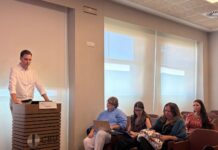
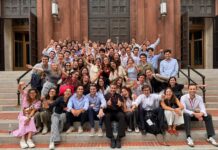
During these last few weeks, the PhD candidate Zitan Peng Hao has participated in two summer courses that have directly contributed to both his academic training and the progress of his doctoral thesis, which focuses on budgetary mechanisms to strengthen the Rule of Law in the European Union.
During the first week, from 24 to 27 June, the PhD candidate attended the Summer School on EU External Action in times of geopolitical changes, organised by the Jean Monnet Module on the Future of Europe at the University of Salamanca. The course was directed by Professor Juan Santos Vara and featured contributions from leading scholars and practitioners such as Fabien Terpan, Elaine Fahey, Jan Wouters, Ramses Wessel, and Stephan Marquardt, among others. Topics addressed included the Common Foreign and Security Policy, European defence, sanctions, trade, climate diplomacy, cybersecurity, and the EU’s relationship with global powers such as the United States, China, and Russia.
One of the most relevant lines of discussion was the EU’s distinctive role as an international normative actor, committed to multilateralism and international law, in contrast to the dynamics of growing power competition. Within this framework, the PhD candidate was able to critically assess and strengthen the preliminary ideas of his research regarding the use of budgetary instruments to promote compliance with the Rule of Law, both within the EU and in its external action.


The second week, from 9 to 11 July, the PhD candidate took part in the summer course “Preparing the Spanish Transition to Democracy”, held at the Monastery of San Jerónimo de Yuste and organised by the European and Ibero-American Academy of Yuste Foundation. The course formed part of the Summer/Autumn International Courses of the University of Extremadura. It was co-directed by Professor Enrique Moradiellos (University of Extremadura) and Professor Antonio Sáez Delgado (University of Évora), and included sessions led by historians, diplomats, political figures, and direct witnesses of the Spanish democratic transition.
Over the course of three days, the programme addressed key themes such as the late-Francoist economy, the role of the Catholic Church, nationalisms, political violence, women’s political participation, and the Iberian path towards common defence. The PhD candidate had the opportunity to attend lectures by figures such as Eduardo Madina, Carlos Aragonés, Francisco Javier Rupérez, and Antonio María Rouco Varela. This course provided valuable insights into the institutional, cultural, and historical dimensions of democratic consolidation, which the candidate relates to the ongoing debates surrounding Rule of Law crises in various European contexts.


Both experiences have greatly contributed to reinforcing the comparative and interdisciplinary approach of the thesis and to expanding the candidate’s theoretical and practical understanding of the tools the EU may use to address current challenges. The PhD candidate highly values the opportunity to link his academic training with interuniversity and cross-disciplinary debates, and wishes to express his appreciation to the organising institutions for their strong commitment to supporting young researchers.