During the month of June, Mateo Baeza Delgado carried out a research stay at the Centro de Estudios Políticos y Constitucionales (CEPC), a leading center for national and international legal and sociopolitical research, under the Spanish Ministry of the Presidency.
Mateo Baeza Delgado is an Assistant Professor in the Department of Political Science, Ethics and Sociology at Universidad CEU Cardenal Herrera, where he teaches courses in the Bachelor’s Degree in Political Science and the Bachelor’s Degree in Journalism, in subjects related to political theory and analysis. Mateo Baeza is also a predoctoral researcher and a member of the research team led by Prof. Dr. Susana Sanz, focused on the crisis of values and identity in the European Union, with particular attention to the analysis of democratic resilience against hybrid threats.
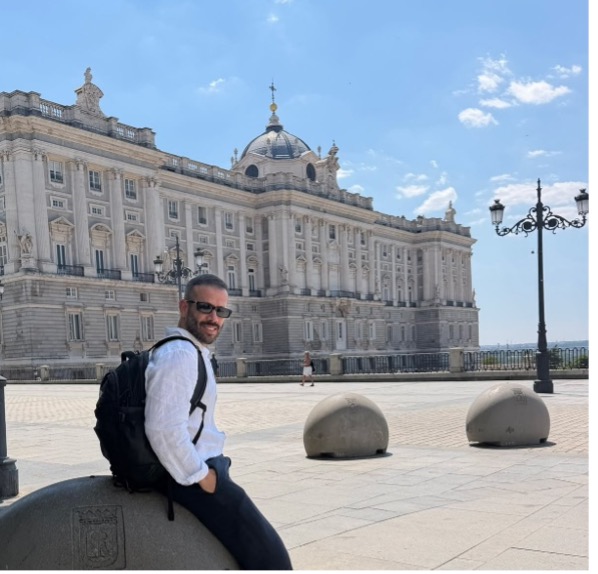
As part of his doctoral thesis, supervised by Prof. Dr. Agustín Domingo Moratalla and Prof. Dr. Leopoldo García Ruiz, he carried out a research stay at the CEPC, located in a privileged setting in Madrid, facing the Royal Palace and next to the Spanish Senate. The Center is an exceptional environment for encounter and dialogue among academic researchers from different disciplines and legal traditions. It currently hosts a large number of researchers, both short- and long-term, from European and American universities.
Mateo Baeza’s doctoral thesis asks how the digital revolution and artificial intelligence are transforming political power, and what must be done to ensure that this transformation does not end up eroding the fundamental rights guaranteed within the framework of European liberal democracies. To analyze the impact of artificial intelligence on fundamental rights, it is not enough to examine the technology alone, nor its possible regulation or governance. It is necessary to review the origin and foundation of the legal-political category of fundamental rights, to reconsider what underpins their protection against power, and how human dignity is understood within a legal and philosophical tradition that predates the digital era.
Accordingly, and thanks to the CEPC’s own resources, the researcher and doctoral candidate was able to revisit some essential figures, such as Peces-Barba —one of the founding fathers of the Spanish Constitution— and his Teoría General. His work makes it possible to establish the protection of fundamental rights based on the projection of human dignity and individual autonomy. Building on this, the doctoral candidate has been able to shape one of the parts of his research, specifically the section devoted to diagnosing the risks that artificial intelligence poses to fundamental rights.
Through the CEPC’s own publications, the researcher has also located and acquired recently published monographs that have proven highly useful, as they provide doctrinal support (and are highly academically robust) for the perspectives and approaches adopted throughout his research.
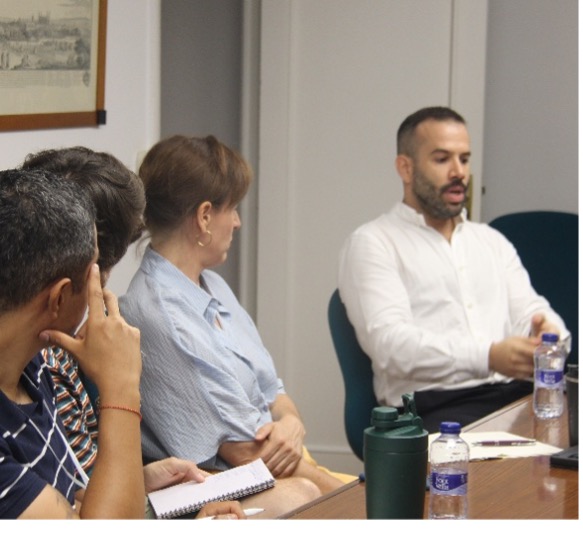
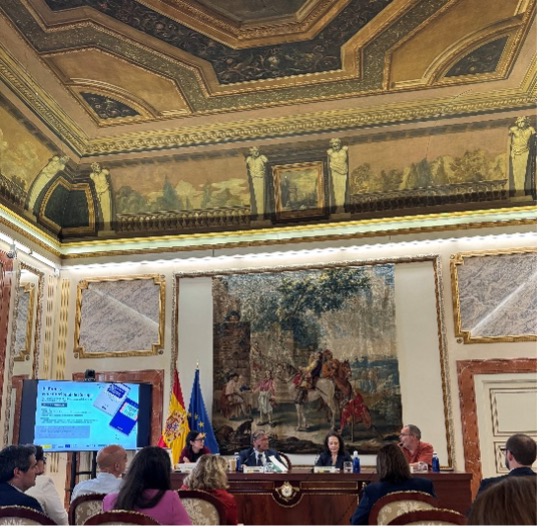
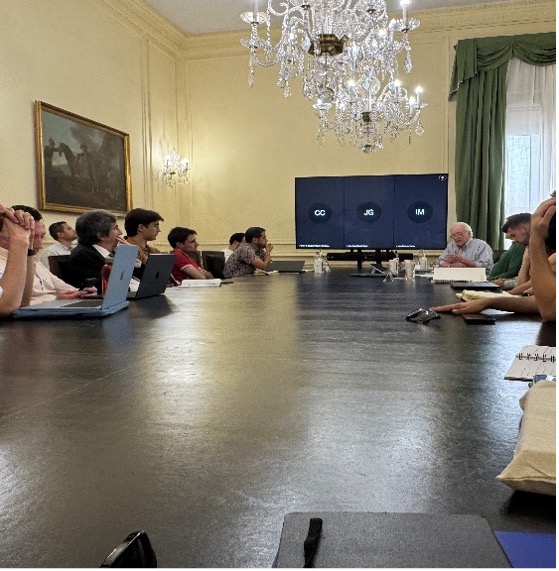
The research stay proved to be highly enriching thanks to the formal conversations and debates held within seminars, as well as the informal ones over a meal or coffee. Conversations and debates that shed light on ideas and require one to defend or (re)articulate one’s own thinking, thereby reinforcing or revising the hypotheses held. In this regard, one particular seminar stands out, in which the doctoral candidate was able to present some of the progress made in his research and which sparked a highly engaging academic debate. Following this presentation, he was able to refine certain aspects of his research and establish direct dialogue with researchers in the same field, dialogue that is expected to continue and grow stronger.
Alongside this, it is worth highlighting the warm welcome extended by the Center’s staff, with whom conversations were also held on current political affairs and on academic and professional backgrounds more broadly, beyond the strict scope of the research itself.
Mateo would like to thank the CEPC for the welcome he received during this month, and all the researchers and staff members whose time and conversations contributed to making this a truly enriching period of research.