During June and July 2026, Carlos González Tormo carried out an intensive programme of international research activities combining research stays, participation in scientific conferences, and collaboration with scholars specialising in Law, Political Science and Communication. These activities contributed to advancing his research on the contemporary challenges facing democracy, the Rule of Law and digital transformation, while fostering the development of new international academic networks.
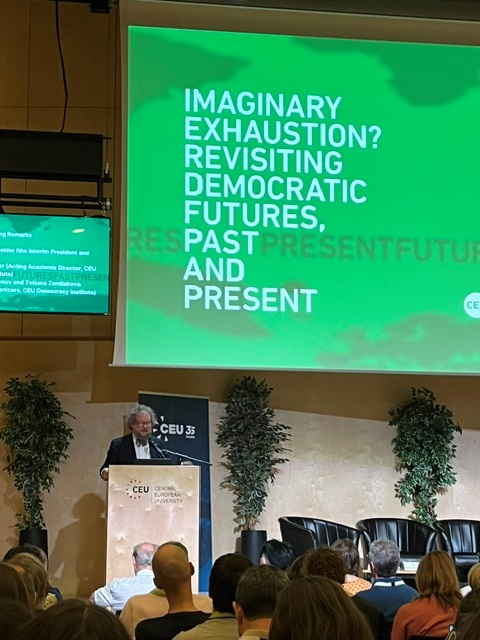
In June 2026, Carlos González Tormo undertook a one-month international research stay at the Center for European Studies in Budapest, Hungary, where he was hosted by Professor Dimitry V. Kochenov, a leading scholar on the Rule of Law, European citizenship and the values of the European Union, and coordinator of the Rule of Law Workgroup at the CEU Democracy Institute. During his stay, he also attended the CEU Democracy Institute Annual Conference 2026, entitled Imaginary Exhaustion? Revisiting Democratic Futures, Past and Present, a leading international conference devoted to examining the present and future challenges confronting contemporary democracies.
Throughout the conference, he engaged with the work of internationally renowned scholars and participated in discussions on issues including the role of the Rule of Law in safeguarding democracy, the implications of migration and illiberal political discourse, the ecological crisis, growing social inequalities, the historical evolution of democratic thought, and emerging forms of political participation and democratic renewal in an increasingly multipolar world.
Subsequently, in July 2026, as part of a predoctoral research stay at the Blanquerna Faculty of Communication and International Relations of Ramon Llull University, Carlos González Tormo participated as a panel speaker in the 21st International Conference on Internet, Law and Politics (IDP), organised by the Faculty of Law and Political Science of the Universitat Oberta de Catalunya (UOC) under the theme Digital Responsibility and Accountability. The conference, held on 2 July 2026 at the UOC Campus in Barcelona, formed an integral part of the academic activities undertaken during his research stay and focused on analysing the challenges that digital transformation poses for democracy, political communication and public institutions.
The IDP Conference is recognised as one of the leading academic forums addressing the legal, political and societal implications of digitalisation, bringing together national and international experts in areas such as artificial intelligence, digital governance, technology regulation and democratic accountability.
Within Panel 1, devoted to Digital Responsibility and Accountability from the Perspective of Political Science and chaired by Professor Núria Franco, Carlos González Tormo presented the paper entitled Parliamentary Committees of Inquiry and Parallel Trials in the Digital Democracy: Synthetic Disinformation, Algorithmic Virality and Accountability. His presentation examined the impact of algorithmically driven information dissemination and synthetic content generation technologies on the functioning of parliamentary committees of inquiry, analysing the challenges these developments pose for democratic safeguards, public opinion formation and the effectiveness of political accountability mechanisms in the digital environment.
During the same month, and within the framework of his predoctoral research stay at the Blanquerna Faculty of Communication and International Relations, Carlos González Tormo conducted research under the supervision of Professor Jaume Suau Martínez, Director of the Digilab Research Group, and member of the research group “The Crisis of the Rule of Law in the European Union.” This research stay enabled him to deepen his quantitative analysis of disinformation, institutional participation, digital political communication and online platforms through an interdisciplinary approach integrating perspectives from Communication, Political Science and Law.
Taken together, these international research activities strengthened the interdisciplinary and comparative dimensions of his research while contributing to the objectives of the research group by fostering collaboration with leading academic institutions and scholars working on democracy, digital transformation and the Rule of Law.