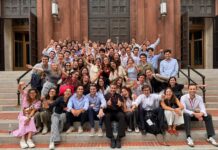
Doctoral candidate Zitan Peng Hao is in his final weeks of his first internationa reseach stay at the Institute for Legal Studies of the Center for Social Science in Budapest, Hungary, under the supervision of Professor Fruzsina Gárdos-Orosz, who during the early months of the stay transitioned from her position as director of the Institute for Legal Studies to Secretary of State at the Ministry of Justice in Hungary’s new governement. The stay has taken place between 1 April and 30 June 2026 and has proven to be one of the most enriching experiences of his doctoral training, both from the academic standpoint and from the perspective of empirical research.

The choice of Budapest as the location for the research stay was no coincidence. The doctoral candidate’s thesis, focused on the political and legal mechanisms for resolving the crisis of values in the Eupean Union, with special reference to budgetary instruments, has Hungary as one of its two main case studies alongside Spain. Arriving in Budapest in April 2026 meant arriving at excatly the right momento: on 12 April 2026, just eleven days after the start of the stay, Hungary’s general elections took place, bringing an end to 16 years of Viktor Orbán’s governement and delivering victory to Péter Magyar with 2/3 majority.
This exceptional circumstances turned the stay into a firstrate field research experience. The doctoral candidate has been able to witness the political transition firsthand, speak with local researchers and legal experts about the implications of the change of government for the Rule of Law, and test the hypotheses of his thesis against the reality he is experiencing on the ground. As some of his colleagues at the institute remarked from the very first day: “you have arrived the best possible moment for you research topic”.
Days after the elections, the Institute for Legal Studies and re:constitution jointly organised a workshop entitled “Hungary 2026: Elections, Institutions, Participation”, a day of analysis of the electoral results that brought together researchers specialising in constitution law, political science and European Union law. The doctoral candidate had the honour of serving for the first time as moderator in two of the forth panels, his first experience in this role at an international forum. The event, which ran from 9:00 to 18:00, generated an intense debate on the institutional implications of the change of government and the prospects for the restoration of the Rule of Law in Hungary.


Throughout the 3 months, Professor Gárdos-Orosz facilitated the doctoral candidate’s access to a wide network of researchers at the institute and other academic institutions in Budapest. Among the most notable activitives, mention should be made of attendance at conferences delivered by professors from the ELTE University, visits to the library of the ELTE Faculty of Law and the Central European University library, as well as guided visit to the Hungarian Parliament Library, which granted the doctral candidate annual access to both its physical collections and its databases.


The doctoral candidate also participated in events organised by the Democracy Institute of the Central European University, where he had the opportunity to meet internationally recognised resesarchers in the field of Rule of Law and members of the research team, such as Professor Dimitry Kochenov, as well as young doctoral candidates working on militant democracies and threats to the Rule of Law. Among the most notable events was the conference “Rule of Law in Crisis” jointly organized by the Democracy Institute and POLEMO.

Informal conversations and shared meals with researchers at the institute proved equally valuable for the progress of the thesis. In particular, the exchange with Dr. Szentgáli-Tóth Boldizsár allowed the doctoral candidate to reflect on the real role that the various EU mechanisms have played in Hungary’s political evolution, including the conditionality regulation, whose effectiveness as an instrument of indirect pressure has been one fo the central debates of the stay.
Beyond the specific activities, the stay has represented a turnng point in the way the doctoral candidate understands the subjetcts of his research. Before arriving in Budapest, the analysis of the Hungarian situation was based exclusively on documents, reports and academic articles. The direct experience has allowed him to nuance and enrich that vision: the everyday reality of Budapest differs from the image that reports on the Rule of law sometimes projects, and understanding that distance is fundamental for a rigorous comparative analysis.
The stay is also confirming one of the central arguments of the doctral work: that the conditionality regulation and the freezing of European funds, while not sufficient instruments on their own, have contributed significantly to creating the conditions that have made political change in Hungary possible. And that the combination of institutional pressue, time, and citizen mobilization are the most effective solutions.
The doctoral candidte wishes to express his most sincere gratitude to Professor Fruzsina Gárdos-Orosz, Mr. János Rékasi and the entire team at the Institute for Legal Studies for their generous welcome, their constant availability, and the extraordinary quality of the academic environment they have made available to him throughout these 3 months.
As a final anecdote: Hungarian citizens have a passion for the Mediterranean too.