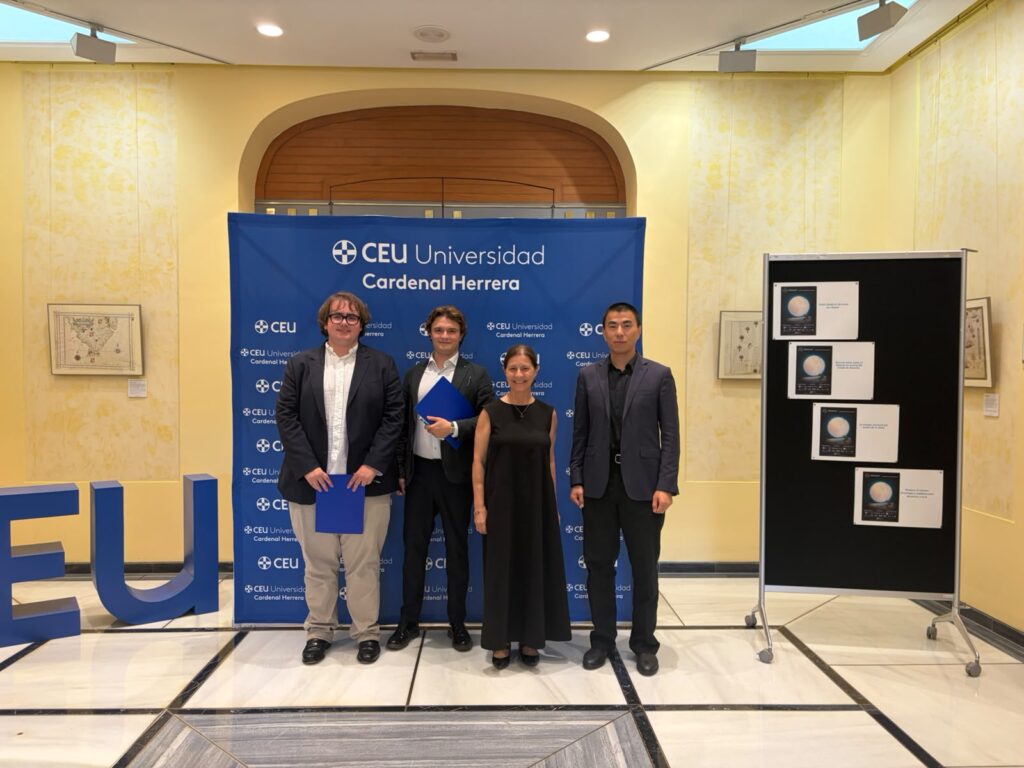
On 25 September, the research team on the Crisis of the Rule of Law in the European Union, led by Professor Susana Sanz Caballero, took part in MEDNIGHT 2026, the Mediterranean Researchers’ Night, held at the Palacio de Colomina of Universidad CEU Cardenal Herrera.
Organised at CEU UCH through the Vice-Rectorate for Research and Knowledge Transfer, the event brought together research groups from a wide range of disciplines with the aim of bringing research closer to society and encouraging young people and university students to discover the world of scientific research. This year, the University organised 38 outreach activities involving more than one hundred researchers and around 300 participants.
Our team participated in the afternoon session with an activity addressed particularly to university students, many of them from scientific and health-related disciplines, as well as PhD candidates from other fields. The session provided an opportunity to show that research does not take place exclusively in laboratories: Law and the Social Sciences also investigate complex phenomena such as the rule of law, democracy, judicial independence and fundamental rights.
The session opened with Susana Sanz Caballero, Principal Investigator of the team, who presented the origins and development of the research group. From its beginnings as a relatively small team, the project has gradually developed into a broad academic network bringing together researchers at different stages of their careers, from PhD candidates to senior professors and full professors at Spanish and international universities.
Professor Sanz also highlighted the team’s growing international dimension, with researchers linked to universities in several European countries, including Hungary, Portugal and Italy, as well as institutions across Spain. This network of cooperation has already produced numerous academic results, including several collective volumes devoted to the crisis of European values and the contemporary challenges facing the rule of law.
Her presentation also introduced the team’s main research areas, which examine how changing forms of political action can affect traditional understandings of the rule of law and how contemporary phenomena such as hybrid threats, disinformation and institutional tensions create new challenges for European democracies.
PhD candidate Enrique Roger Belloch then provided a conceptual introduction to the meaning of the rule of law. His presentation began with a fundamental distinction: the rule of law does not simply mean that citizens are subject to legal rules, but that the exercise of public power itself is constrained by law.
From this perspective, he outlined some of its core elements, including the principle of legality, the separation of powers, judicial independence, the recognition and protection of fundamental rights, legal certainty and the subjection of public authorities to the legal order. Law has historically served to regulate social life, but the ideal of the rule of law requires that this legal ordering also respond to demands of legal certainty and justice.
A central question underlying the team’s research is therefore the extent to which contemporary transformations in political practice and in the understanding of law may come into tension with these traditional foundations.
PhD candidate Zitan Peng Hao subsequently explored the European dimension of this issue, presenting some of the major challenges currently facing the rule of law in the European Union. His contribution focused particularly on judicial independence, the separation of powers and the relationship between national legal systems and the European legal order.
Drawing on developments concerning countries such as Hungary and Poland, the presentation examined some of the conflicts that have led EU institutions to develop mechanisms designed to safeguard the rule of law. The rule of law is one of the values on which the European Union is founded under Article 2 of the Treaty on European Union, alongside democracy, human rights, freedom, equality and human dignity.
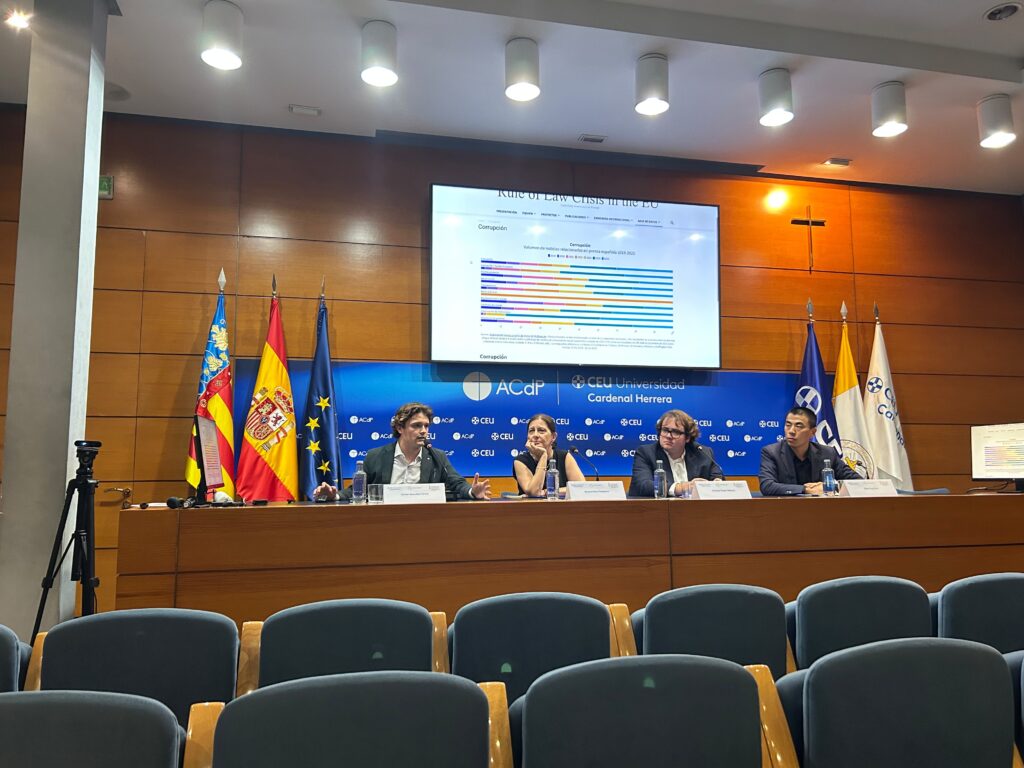
The final presentation was given by Carlos González Tormo, who introduced one of the team’s main methodological and outreach tools: its database on the rule of law and the media.
The database collects and analyses material from the newspaper archives of some of Spain’s leading media outlets in order to quantitatively measure the prominence given to different dimensions of the rule of law.
Its results are organised around four main areas — judicial independence, corruption, human rights and media pluralism — selected from an academic perspective and in accordance with the structure of the European Commission’s Rule of Law Report. Through a series of interactive graphs, the database makes it possible to observe the prominence of these issues in public debate and to analyse their evolution quantitatively.
The team’s participation in MEDNIGHT therefore provided an opportunity to present both the theoretical questions underlying our research and some of its concrete outputs in an accessible format. In particular, it allowed students from other academic disciplines to see how research in Law and the Social Sciences can also formulate hypotheses, collect evidence and develop analytical tools for understanding contemporary problems.
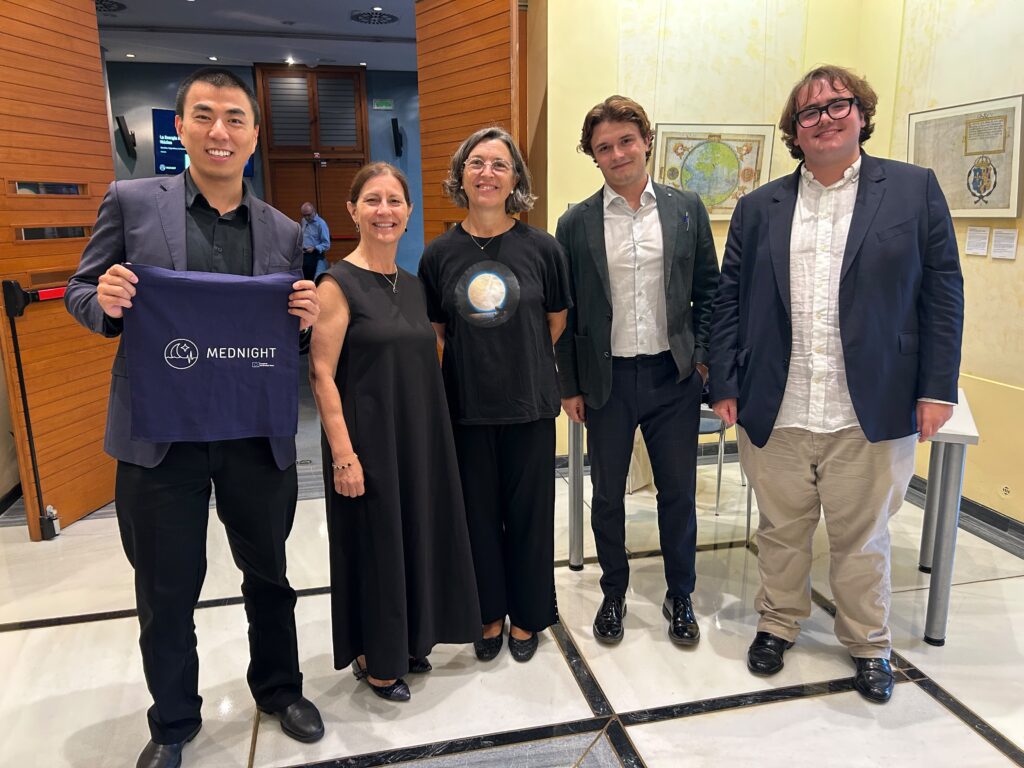
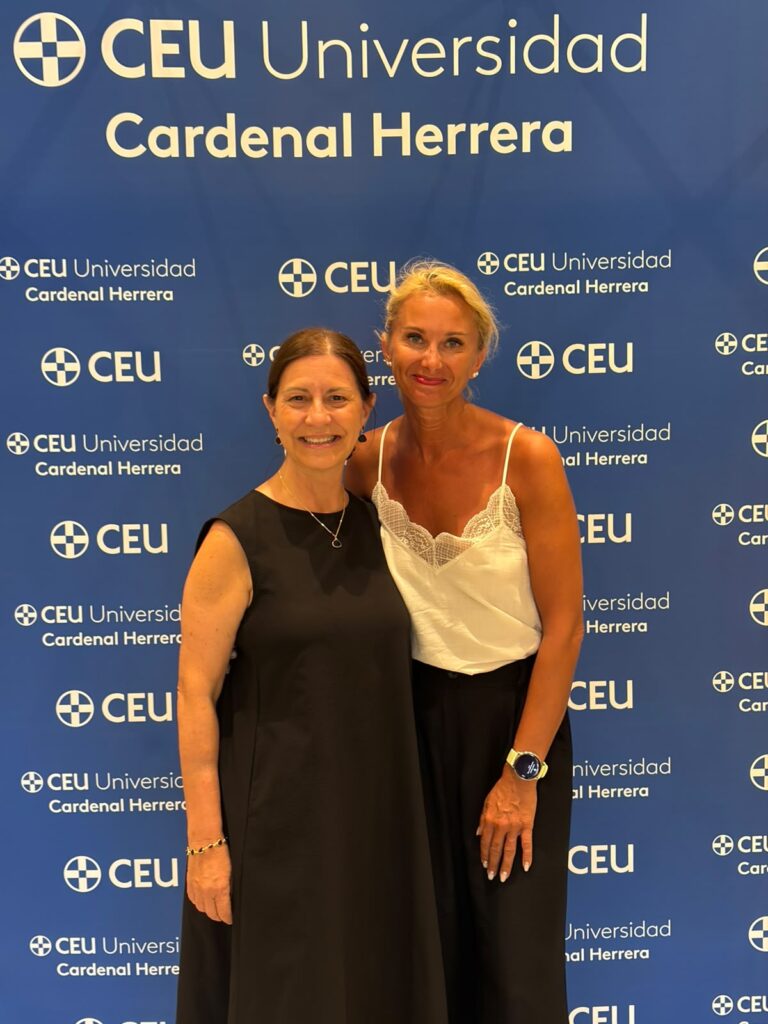
The event was also attended by Alicia López Castellano, Vice-Rector for Research and Knowledge Transfer at Universidad CEU Cardenal Herrera, who visited the activity and spoke with members of the team about the session and their ongoing research.
The relevance of this line of research was subsequently highlighted by the Vice-Rector herself in an interview published by El Debate. When discussing some of the research currently being conducted at the University, Alicia López Castellano specifically referred to the rule of law research led by Professor Susana Sanz, emphasising its relevance in the context of contemporary crises and challenges.
The session was also attended by Professor Katarzyna Kułak-Krzysiak from the John Paul II Catholic University of Lublin, an international collaborator of the research team. Her presence offered a tangible example of the group’s international dimension and of the ongoing cooperation developed with researchers from universities across Europe.
Our participation in MEDNIGHT 2026 therefore represents another opportunity to take research beyond strictly academic settings and to share with students and the wider public some of the questions that guide our work: what it really means to live under the rule of law, what conditions are necessary to preserve it and what major challenges it currently faces in Europe.
Researching the rule of law also means researching the conditions that make a democratic society governed by law possible.