Last Monday, 7 September, the presentation of the book Overcoming the Crisis of Democratic Values in the European Union took place in the Salón de Grados of the Library at Universidad CEU Cardenal Herrera. This collective volume is the result of the research conducted within the framework of the projects led by Professor Susana Sanz Caballero.
The presentation brought together several of the book’s contributors and was opened by the Dean of the Faculty, a member of the research team and one of the co-authors of the volume, Prof. Leopoldo García Ruiz, who expressed his satisfaction at hosting the presentation of a book produced by a professor from the Faculty and closely connected to one of the research group’s main lines of inquiry. He also highlighted the structure of the work’s two volumes, which make it possible to address, from a range of perspectives, the principal challenges currently affecting the rule of law in the European Union.
One of the key features highlighted during the presentation was precisely the diversity of approaches and backgroundsrepresented in the volume. Its contributors include researchers from different countries and academic traditions, including Poland and Hungary, as well as specialists in constitutional law, legal theory, communication theory, and members of the judiciary. This diversity provides a broad and multidisciplinary perspective on the crisis of democratic values currently affecting Europe.

For his part, Prof. Manuel Martínez Sospedra addressed the evolution of the case law of the Court of Justice of the European Union and the development of what may be described as European rule-of-law standards. In recent years, the CJEU has progressively consolidated an interpretation according to which EU law and national legislation must be compatible with the principles deriving from the rule of law and with the right to effective judicial protection, particularly through Articles 2 and 19 of the Treaty on European Union. This jurisprudential development has significant legal and political implications and demonstrates the increasingly prominent role played by common principles and values in shaping the European Union’s legal order.
The next speaker was Prof. Antonio Bar Cendón, Professor at the University of Valencia, who recalled his collaboration with Susana Sanz and emphasised the importance of the research projects they have undertaken together. His contribution focused on the crisis that, in recent years, has affected the fundamental values of the European Union and, with them, the principles underpinning the rule of law. The erosion of mechanisms designed to limit and control public power, the weakening of institutional checks and balances, and the questioning of the role of parliaments are, in this respect, problems that transcend national borders. All these issues are directly connected to the values enshrined in Article 2 of the Treaty on European Union.
Corruption and digital transformation were at the heart of the contribution by Prof. Marta Pérez Gabaldón, Vice-Dean of the Degree in Political Science at Universidad CEU Cardenal Herrera. She stressed that corruption is a matter of concern not only for the European institutions, but also for citizens themselves. Technology has a dual dimension in this field: it can help strengthen transparency and prevent certain unlawful practices, while at the same time facilitating new forms of fraudulent conduct. Artificial intelligence, whistleblower protection, transparency portals and e-government therefore emerge as tools with considerable potential to strengthen public integrity. These measures must, however, be accompanied by a robust regulatory framework, a stronger culture of political integrity and an independent judiciary. The need to address challenges such as the digital divide and security vulnerabilities was also emphasised.
Prof. Clara Portela of the University of Valencia, co-author of the chapter together with Adam Holesch and Ruth Ferrero-Turrión, presented the principal findings of their research on the European Union’s response to democratic backsliding in Hungary, considered in parallel with the Polish case. Her contribution provided an opportunity to reflect on the instruments available to the Union to respond to the deterioration of the rule of law. Beyond the well-known procedure laid down in Article 7 of the Treaty on European Union, other mechanisms have assumed particular importance, including infringement proceedings initiated by the European Commission and, especially, the conditionality mechanism, which has demonstrated a particularly significant capacity for action.
From a different perspective, researcher Davor Petric analysed the role of national courts in safeguarding the European rule of law. The development of doctrines established by the CJEU, such as direct effect and State liability, has conferred new responsibilities and duties upon national judges in ensuring the effective application of EU law. In this sense, it is possible to speak of a genuine European mandate for national judges, closely connected to judicial independence. This mandate affects not only the formal structure of national judicial systems but may also influence the legal and political culture of the Member States.
Judicial independence was also the central theme of the contribution by research team member Almudena del Castillo Santamaría, who raised a fundamental question: is the Court of Justice of the European Union protecting judicial independence consistently, or do significant gaps remain? The available data illustrate the scale of the problem. During the 2019–2024 period, a large majority of EU Member States experienced a deterioration in the rule-of-law indicators compiled by the World Justice Project. Moreover, the erosion of judicial independence can no longer be regarded as a phenomenon confined to young or consolidating democracies; it also affects democracies with long-established institutional traditions.
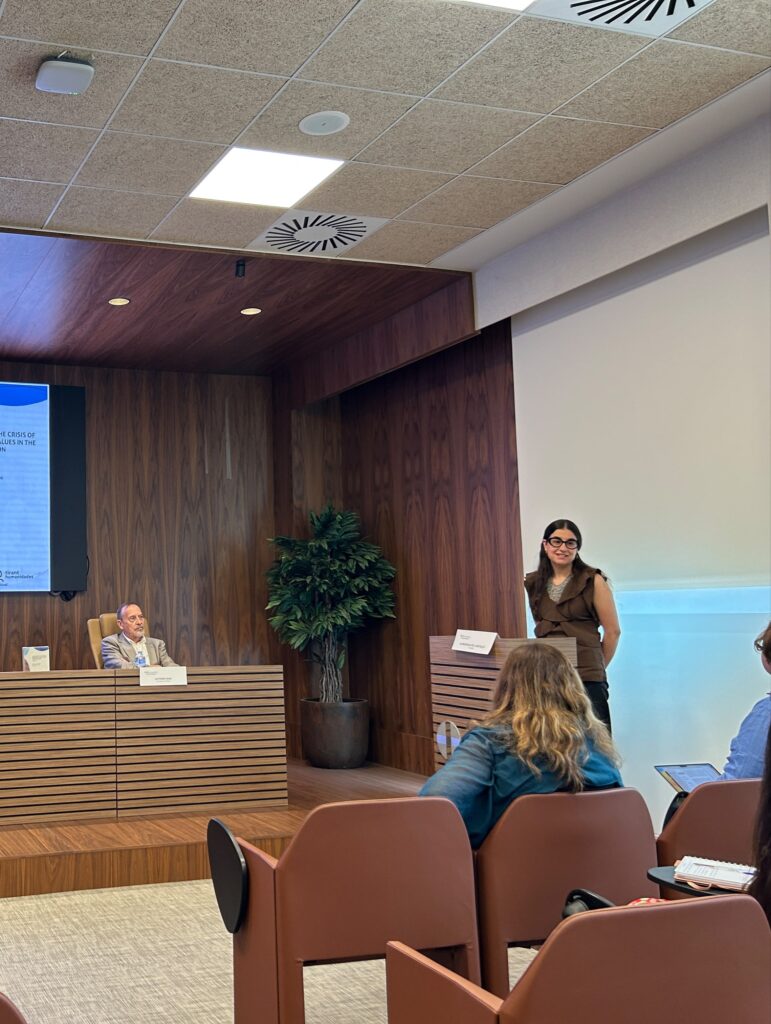
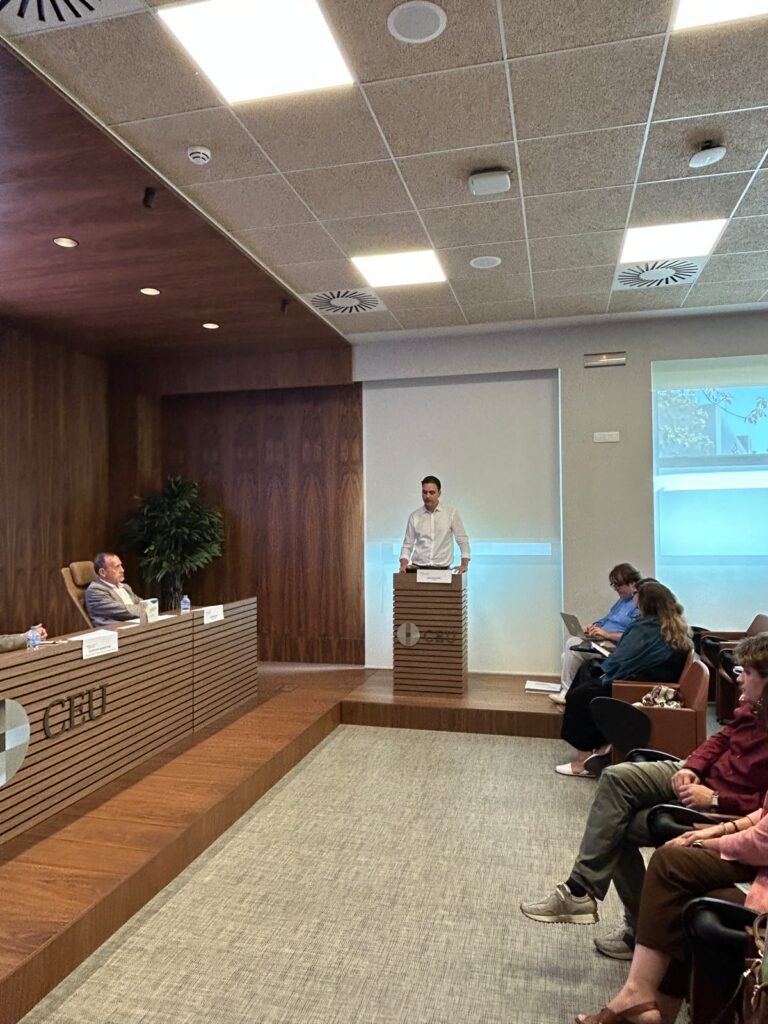
Finally, Susana Sanz Caballero, Principal Investigator of the research projects from which the book emerged, explained the origins of the volume, which can be traced back to the International Conference Overcoming the Crisis of Democratic Values in the European Union, held in October 2024. The decision to publish the book in English reflects the aim of broadening its reach and facilitating its dissemination within the international academic community.
In her contribution, Sanz Caballero also stressed the importance of continuity across research projects, which has made it possible to build upon successive initiatives funded by the Generalitat Valenciana and the Spanish Ministry of Science and Innovation, as well as to develop a range of instruments for knowledge transfer and scientific dissemination, including the research group’s blog and a specialised database.
The presentation of Overcoming the Crisis of Democratic Values in the European Union therefore marks a further step in a long-standing line of research devoted to examining the challenges facing the European Union’s foundational values. The rule-of-law crisis, judicial independence, corruption, technological transformation, the institutional response of the European Union and the role of national courts are among the central issues addressed throughout this collective work. While acknowledging the depth of the challenges currently facing Europe, the volume also affirms the capacity of institutions, researchers and citizens to contribute to European democratic resilience.
As Eisenhower once observed, in a statement that encapsulates one of the ideas inspiring the work of the research group: “The clearest way to show what the rule of law means to us in everyday life is to recall what has happened when there is no rule of law.”