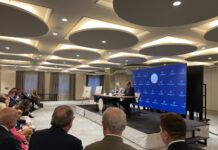
On November 6, Dr. Marcos F. Soler, Director of the Center for Ethics and the Rule of Law (CERL) at the University of Pennsylvania, visited the School of Law, Business, and Political Science at UCH-CEU to deliver a seminar to members of the research team “Crisis of the Rule of Law in the EU”, led by the group’s Principal Investigator and Full Professor, Susana Sanz Caballero.

The seminar, based on Dr. Soler’s current work in progress, was titled “Crisis of the Rule of Law in the U.S.: Military Mobilization and Judicial Response.”
Dr. Soler has an extensive background in public administration—he previously served as the head of public safety for the State of New York and as Director of the Mayor’s Office of Criminal Justice in New York City. Drawing on this experience, he offered participants both an empirical and critical reflection on the institutional drift currently affecting the U.S. constitutional system.
According to Dr. Soler, international indicators—such as the World Justice Project Rule of Law Index—show a steady decline in the respect for the rule of law in the United States, visible in three main areas:
-Expansion of executive power, with the President assuming legislative functions and weakening institutional checks and balances.
-Growing distrust toward the judiciary, increasingly perceived as politically biased.
-Instrumental use of law for political ends, a phenomenon often referred to as lawfare.
While these trends are not new—there are many precedents both in the U.S. and abroad—the Trump administration has accelerated them. The revival of theories such as the unitary executive theory—which posits that the President holds nearly all executive authority without the need for legislative oversight—and the Schmittian reinterpretation of the state of exception—which frames society as being in a permanent state of emergency where every event becomes a potential threat—have both fostered a more authoritarian conception of political leadership.
One of the central topics addressed during the seminar was the domestic deployment of military forces within U.S. territory, a practice arguably at odds with the principles of federalism and civilian control over the armed forces.
Since 2025, President Trump has issued several presidential memoranda authorizing the deployment of the National Guard (which normally falls under the authority of state governors and may only be federalized in specific cases) and even regular troops in cities such as Los Angeles, Chicago, Portland, and Washington, D.C., citing alleged public order or immigration emergencies. According to Dr. Soler, these deployments violate both the Tenth Amendment—which establishes that “powers not delegated to the United States by the Constitution, nor prohibited by it to the States, are reserved to the States respectively, or to the people”—and the Posse Comitatus Act, which prohibits the use of the military for domestic law enforcement without congressional authorization.
Dr. Soler also illustrated the extreme polarization of American society with recent data: about 25% of the population—and up to 36% of Republican voters—believe it is acceptable for the President to break the law “for a good cause.” This “authoritarian third”, as he called it, has grown significantly over the past decade and shows the lowest adherence to the principles of the rule of law.
The result, according to the researcher, is an imperial presidency strengthened by a citizenry increasingly distrustful of institutional checks and balances and more willing to accept permanent exceptionalism as a form of governance.
Dr. Soler concluded that the crisis of the rule of law in the United States is both institutional and cultural: the executive branch continues to expand, the judiciary loses legitimacy, and the logic of emergency replaces democratic debate. Civilian control of the military, he emphasized, is not a mere technicality—it is the cornerstone of individual liberty and the balance of powers.
His ongoing research at CERL forms part of a broader effort to reconnect national security with the democratic and constitutional values on which the American republic was founded.