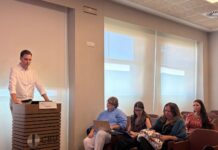
On Thursday, 26 February 2026, the conference “Freedom of Expression, Disinformation and the Rule of Law in Europe” took place at the Palacio de Colomina, organised by the research group on the crisis of the Rule of Law in the European Union at CEU Cardenal Herrera University. This activity forms part of the research project PID2021‑126765NB‑100, funded by the Ministry of Science and Innovation and entitled “Crisis of the Rule of Law in Europe”, led by Susana Sanz Caballero and Antonio Bar Cendón. Within the framework of this project, an international team of fifteen researchers from six European countries has spent the past four years analysing and reflecting on the attacks suffered by the Rule of Law in Spain, Estonia, Croatia, Italy, Poland and Hungary, as well as in the European Union more broadly.
Professor of Public International Law Susana Sanz Caballero, leader of the CEU‑UCH research group, referred to a new research project funded by the Generalitat Valenciana that has recently been awarded to the team to investigate the relationship between the decline of the Rule of Law and hybrid threats. In her presentation, she noted: “While debating within our research group, we realised that a key factor was the disinformation spread by both state and non‑state actors.”

Link to the Actualidad CEU news article: Expertos internacionales evalúan en Valencia cómo afecta la desinformación y la falta de pluralismo mediático al Estado de Derecho en Europa
The event began with the presentation of a database that analyzes media coverage and the presence in the Spanish press of terms associated with the concept of the Rule of Law. The presentation was delivered by Carlos González Tormo, adjunct professor in the Department of Political Science at CEU UCH, and the tool was developed within the research group led by Dr. Sanz.
This database covers the period from 2019 to 2025 and makes it possible to identify changes such as those observed in the Spanish press since 2024, where issues like corruption cases or media pluralism have increasingly been linked to the crisis of the Rule of Law. In this regard, until 2024 human rights appeared as an isolated topic, whereas they are now addressed in a more structural manner and are discussed alongside coverage of war and armed conflicts by the media.


The first roundtable, titled “Media Pluralism and Information Capture: Legal and Regulatory Aspects,” was moderated by Dr. Jorge Cardona, Professor of Public International Law at the University of Valencia, who stated: “Information capture is the structural distortion of the public sphere and strategic disinformation when it is promoted by state or para‑state actors for political purposes.” He emphasized the importance of bringing together freedom of expression, the integrity of the public sphere, and sovereignty. He concluded by posing the following question to open the intellectual debate among the speakers: “How can we protect democracy without weakening pluralism?”
Irene Roche Laguna, Head of Unit at the European Commission responsible for the coordination and enforcement of the Digital Services Act and the Digital Markets Act, focused her remarks on “the European regulatory framework: the Digital Services Act, the European Democracy Action Plan, the EU, the Media Freedom Act, and the limits to freedom of expression.”
As a specialist in the field, she was able to describe firsthand how EU legislation is applied in practice. “When we began working on the DSA, the Charter of Fundamental Rights was applied vertically. However, the CJEU had already begun applying it horizontally.” These mechanisms have an impact, and content‑moderation decisions on platforms are becoming increasingly frequent. Evidence of this is that, since the first half of 2025, nine billion content‑moderation decisions have been recorded, 99% of which are based on the platforms’ own terms and conditions for content moderation, rather than on decisions imposed by a public authority, as Irene Roche explained.
Regarding questions about who censors the internet, the expert responded that it is the platforms themselves. Platforms are responsible for content, but the Digital Services Act (DSA) seeks to ensure that they are not held liable for the content itself and that their role focuses on organizing it, an obligation imposed by the DSA.

Algorithms also influence national and European electoral processes. Although the labeling of deepfakes improved during the 2024 European elections, thereby reducing the presence of AI‑generated fabricated content, it is ultimately algorithms that determine what content reaches users, as the Head of Unit at the Commission noted. This dynamic greatly contributes to reinforcing the phenomenon of media capture.
Jaume Suau Martínez, principal investigator at DIGILAB: Media, Strategy and Regulation, within the Blanquerna School of Communication and International Relations at Ramon Llull University, focused his presentation, titled “The State of Disinformation in Europe: Which Instruments Have Worked and Which Have Not?”, on the importance of information integrity and the role of media pluralism, grounded in transparent systems and a genuinely pluralistic environment.
The attack on the necessary integrity of information can occur not only through disinformation and hate speech, but also through the generation of informational noise. It becomes particularly concerning “when conditions are created or facilitated that lead people to stop believing in shared realms of truth.”
Dr. Suau highlighted the need to establish standards that allow for measuring trust in the quality of media coverage. He also noted that it is possible to identify how different types of content refer to specific ideas in order to study the impact of disinformation and analyze how these narratives influence public opinion.
In light of this situation, Jaume Suau advocates for citizens to adopt a responsible approach regarding the origin of the information they receive, while also emphasizing the importance of traditional media in countering disinformation outlets. Finally, he pointed out that legislative initiatives could help regulate disinformation, although doing so would require political consensus to avoid potential forms of censorship.


Lastly, Dr. Carlos Espaliú Berdud, Professor of Public International Law and International Relations at the University CEU Fernando III, concluded the first roundtable with a presentation on “The European Union’s Fight Against Disinformation Sponsored by Foreign States.” He began by noting that information manipulation is not a new phenomenon and can be used for economic, political, and even military purposes, becoming extremely harmful when it takes the form of a disinformation campaign. He defined disinformation as: “The orchestrated dissemination of false news through television channels, newspapers, or social media with the aim of securing an economic or political benefit for an individual or a State.”
Drawing on the case law of the Court of Justice of the European Union, Dr. Espaliú reviewed how disinformation has been addressed, emphasizing respect for differing opinions and the possibility of debating information and the potential falsity of the content to which citizens are exposed. In light of the use of disinformation as a hybrid threat, he cited several studies, noting that “our media have become a geopolitical battleground.”
In this regard, Carlos Espaliú made a historical distinction between the “paper war” fought by the EU through soft‑law mechanisms and the paradigm shift that occurred from 2022 onward with the adoption of hard‑law instruments. “In 2022, the EU created the Strategic Compass, a key document,” he explained, proposing a much more stringent set of measures to counter foreign disinformation campaigns.
The speaker noted that a large‑scale disinformation campaign capable of causing severe consequences, such as genocide or secession, could even be considered an armed attack. He also pointed out that, although it is difficult today to imagine a campaign directed exclusively against the EU, if such a scenario were to occur, the Union itself would not be able to defend itself directly; however, Member States could do so by invoking the mutual assistance clause under Article 42.7 of the Treaty on European Union. Finally, he stressed that the EU’s response to disinformation has evolved from more flexible instruments to a more robust regulatory framework, although its effectiveness ultimately depends on cooperation among institutions, private actors, and citizens.

The second roundtable, titled “Disinformation as a Hybrid Threat to Democracy”, was moderated by Clara Portela, Associate Professor of Political Science at the University of Valencia and a member of the research team led by Dr. Sanz on the crisis of the Rule of Law in the EU.
Leopoldo García Ruiz, Professor of Philosophy of Law at CEU Cardenal Herrera University and member of the research group, referred to hybrid threats by noting that “anyone with an interest in influencing public discourse can resort to multiple disinformation strategies, hire professionals in digital media, or rely on memes, heirs to the classic political caricature, which spread rapidly and are highly effective.” Dr. García Ruiz also described the scenario of so‑called “cognitive warfare” as an evolution of traditional propaganda, characterized by its greater capacity for dissemination and lower cost. In this context, he pointed out that disinformation has become a common tool, used both by autocratic states and by others whose political systems resemble those of Western democracies.


However, some of the proposed measures include ensuring the existence of free and pluralistic media in Europe in order to improve transparency regarding media ownership, as envisaged by the DSA mechanism. Among the proposals are guaranteeing the right to information so as to demand greater transparency, both algorithmic and from those in government, and establishing sanctions in cases of repeated non‑compliance, including the possibility of disqualification from holding public office. Another measure involves strengthening shared narrative frameworks, such as the official French government account dedicated to countering disinformation by debunking and persuading.
Professor Leopoldo García Ruiz concluded his remarks by noting that freedom of expression makes us vulnerable and is exploited by external actors, but it also “makes us who we are, and defending it allows us to remain consistent with our values.”
Paulina Astroza Suárez, PhD in Political and Social Sciences (International Relations), Jean Monnet Chair and Director of the Center for European Studies at the University of Concepción (Chile), delivered a presentation titled “The Necessary Balance Between Security, Pluralism, and the Rule of Law.” She argued that there is a competitive rivalry with the United States, particularly in areas such as artificial intelligence, data, and fiber‑optic infrastructure.
In this regard, she described several actions taken by the U.S. administration that affect Chilean technological sovereignty. While structural changes can be observed, the scholar emphasized that “we are living through tectonic moments in international relations.” We therefore find ourselves in an infodemic: we have access to vast amounts of information, yet at the same time we do not know what is true and what is not. It is also important to note that disinformation today has a strong emotional impact, and these emotions in turn affect democracy itself, influencing electoral processes. Faced with this situation, Paulina Astroza highlighted the importance of digital literacy and stressed the need not to remain silent, as doing so would leave the public sphere in the hands of those who use these channels to spread disinformation.


For her part, Marta Hernández Ruiz, Assistant Professor of International Relations at Loyola University Seville, noted, regarding “The Responsibility of Digital Platforms”, that the way citizens perceive information has a direct impact on their behavior, including during elections.
Within the European Union, there is a line of action focused on directly combating disinformation, understood as a hybrid threat, while progress has also been made toward structural reforms. Likewise, various psychological studies show how disinformation affects public opinion, since the impact of a falsehood is not always corrected even when accurate information is later provided. Since the creation of the voluntary Code of Good Practices, tools such as the Digital Services Act have been developed to counter disinformation. However, academics and observatories continue to assess the degree to which platforms are implementing the commitments set out in the Code.
Regarding the reaction to EU hard‑law regulations aimed at addressing disinformation, monitoring by platforms designated as VLOPs (very large online platforms) is particularly relevant in order to verify compliance with their obligations. In this regard, the establishment of an ad repository is essential for identifying who finances advertising on platforms, especially political advertising. For this reason, the EU Regulation governs the transparency and targeting of political advertising.
Finally, during her presentation, Dr. Hernández discussed several cases addressed by the Court of Justice of the European Union concerning the implementation of the DSA and other regulatory instruments by platforms, particularly very large online platforms (VLOPs). In this context, she emphasized that “disinformation must be addressed from a dual perspective: the joint fight against disinformation and the defense of the Rule of Law.”

For all these reasons, it can be concluded that the conference organized by the research group of CEU Cardenal Herrera University offered both the speakers and the attending public the opportunity to share their views on the phenomenon of disinformation, which is employed by various actors as a deterrent and, in many cases, with polarizing intent. In the face of new hybrid threats to the stability of the Rule of Law, and in addition to providing a critical perspective on disinformation, experts agree on the need for citizens to ask themselves: who is giving me this information, how they are presenting it, and why they are telling it to me.